
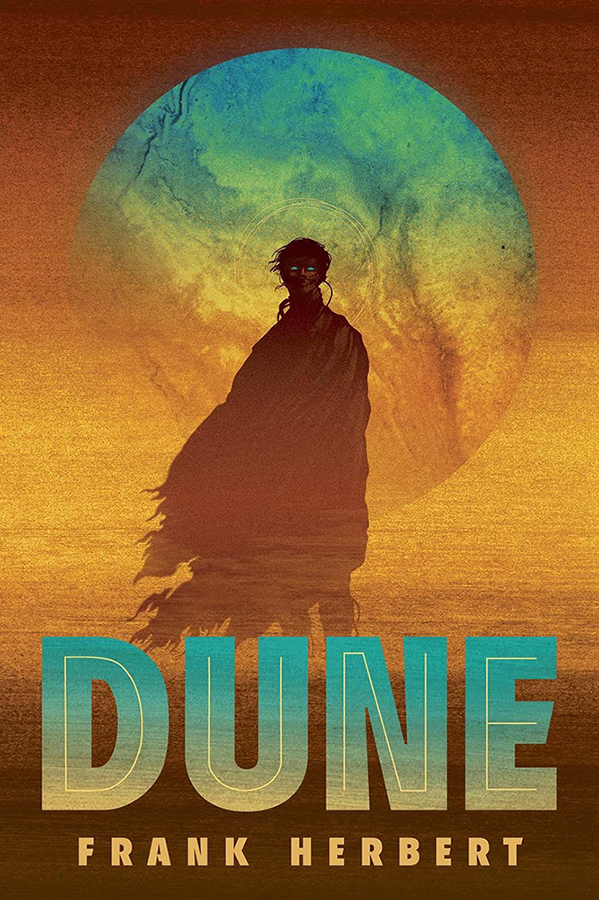
Dune
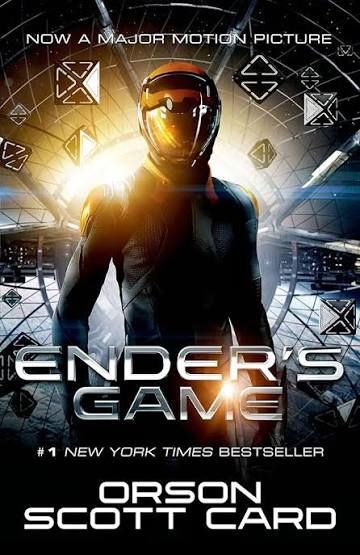
Ender’s Game
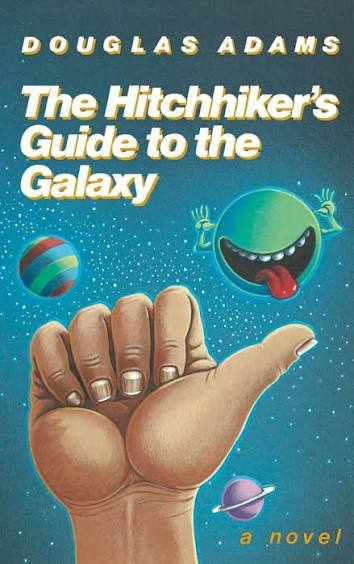
The Hitchhiker's Guide to the Galaxy
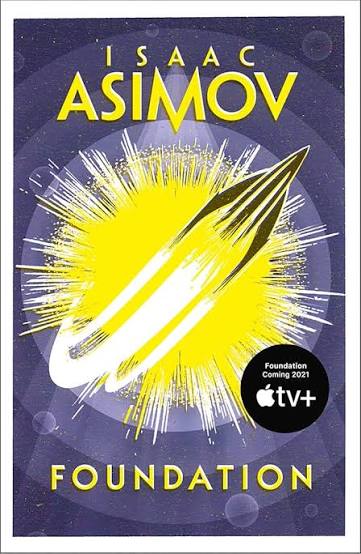
Foundation
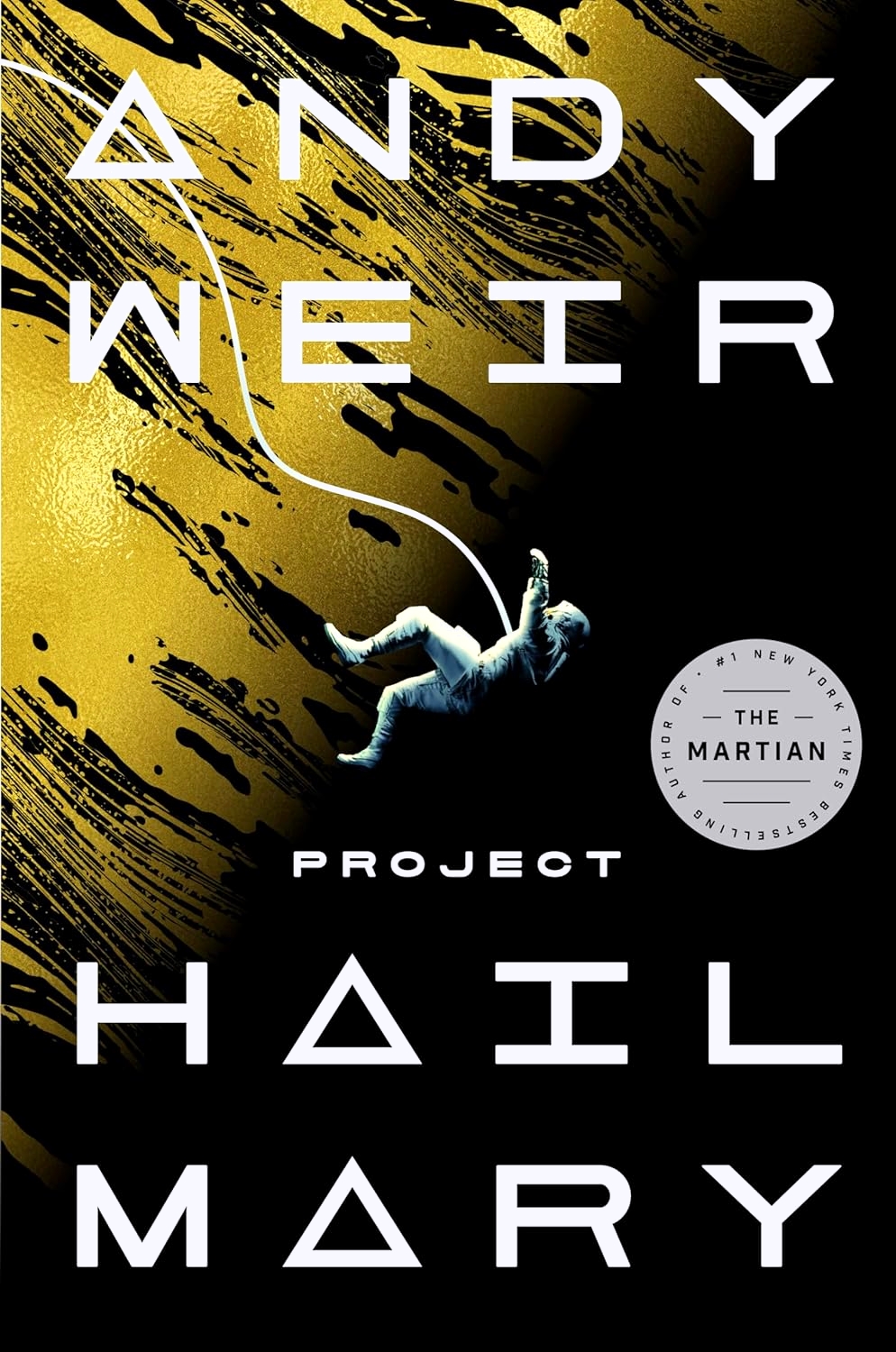
Project Hail Mary
|
Dune |
Ender’s Game |
The Hitchhiker's Guide to the Galaxy |
Foundation |
Project Hail Mary |
|---|---|---|---|---|---|
|
|
|
|
|
Dune is a 1965 epic science fiction novel by American author Frank Herbert, originally published as two separate serials (1963–64 novel Dune World and 1965 novel Prophet of Dune) in Analog magazine. It tied with Roger Zelazny's This Immortal for the Hugo Award for Best Novel and won the inaugural Nebula Award for Best Novel in 1966. It is the first installment of the Dune Chronicles. It is one of the world's best-selling science fiction novels.[4]
Dune is set in the distant future in a feudal interstellar society, descended from terrestrial humans, in which various noble houses control planetary fiefs. It tells the story of young Paul Atreides, whose family reluctantly accepts the stewardship of the planet Arrakis. While the planet is an inhospitable and sparsely populated desert wasteland, it is the only source of melange or "spice", an enormously valuable drug that extends life and enhances mental abilities. Melange is also necessary for space navigation, which requires a kind of multidimensional awareness and foresight that only the drug provides. As melange can only be produced on Arrakis, control of the planet is a coveted and dangerous undertaking. The story explores the multilayered interactions of politics, religion, ecology, technology, and human emotion as the factions of the empire confront each other in a struggle for the control of Arrakis and its spice.
Herbert wrote five sequels: Dune Messiah, Children of Dune, God Emperor of Dune, Heretics of Dune, and Chapterhouse: Dune. Following Herbert's death in 1986, his son Brian Herbert and author Kevin J. Anderson continued the series in over a dozen additional novels since 1999.
Adaptations of the novel to cinema have been notoriously difficult and complicated. In the 1970s, cult filmmaker Alejandro Jodorowsky attempted to make a film based on the novel. After three years of development, the project was canceled due to a constantly growing budget. In 1984, a film adaptation directed by David Lynch was released to mostly negative responses from critics and failure at the box office, although it later developed a cult following. The book was also adapted into the 2000 Sci-Fi Channel miniseries Frank Herbert's Dune. A second film adaptation, directed by Denis Villeneuve, was released on October 21, 2021, to positive reviews. It went on to be nominated for ten Academy Awards, including Best Picture, ultimately winning six. Villeneuve's film covers roughly the first half of the original novel; a sequel, which covers the second half, was released on March 1, 2024, to critical acclaim. A third film is set to release on December 18, 2026, based on Dune Messiah, the sequel to Dune.
The series has also been used as the basis for several board, role-playing, and video games.
Since 2009, the names of planets from the Dune novels have been adopted for the real-life nomenclature of plains and other features on Saturn's moon Titan.
Ender's Game is a 1985 military science fiction novel by American author Orson Scott Card. Set at an unspecified date in Earth's future, the novel presents an imperiled humankind after two conflicts with an insectoid alien species they dub "the buggers". In preparation for an anticipated third invasion, Earth's international military force recruits young children, including the novel's protagonist, Andrew "Ender" Wiggin, to be trained as elite officers. The children learn military strategy and leadership by playing increasingly difficult war games, including some in zero gravity, where Ender's tactical genius is revealed.
The book originated as a short story of the same name, published in the August 1977 issue of Analog Science Fiction and Fact.[1] The novel was published on January 15, 1985. Later, by elaborating on characters and plotlines depicted in the novel, Card wrote additional books in the Ender's Game series. Card released an updated version of Ender's Game in 1991, changing some political facts to account for the then-recent dissolution of the Soviet Union and the end of the Cold War. The novel has been translated into 34 languages. In the movie adaptation and novels after the original sequels, "buggers" are referred to as "Formics".
Reception of the book has been largely positive. It has become suggested reading for military organizations such as the United States Marine Corps.[2] Ender's Game was recognized as "best novel" by the 1985 Nebula Award[3] and the 1986 Hugo Award[4] in the genres of science fiction and fantasy. Its four sequels—Speaker for the Dead (1986), Xenocide (1991), Children of the Mind (1996), and Ender in Exile (2008)—follow Ender's subsequent travels to many different worlds in the galaxy. In addition, the later novella A War of Gifts (2007) and novel Ender's Shadow (1999), plus other novels in the Shadow saga, take place during the same time period as the original.
A film adaptation of the same name, written for the screen and directed by Gavin Hood, and starring Asa Butterfield as Ender, was released in October 2013. Card co-produced the film.[5] The novel has also been adapted into two comic book series.
The Hitchhiker's Guide to the Galaxy[a][b] is a comedy science fiction franchise created by Douglas Adams. Originally a radio sitcom broadcast over two series on BBC Radio 4 between 1978 and 1980, it was soon adapted to other formats, including both novels and comic books, a 1981 BBC television series, a 1984 text adventure game, stage shows and a 2005 feature film.
The Hitchhiker's Guide to the Galaxy is an international multimedia phenomenon; the novels are the most widely distributed, having been translated into more than 30 languages by 2005.[4][5] The first novel, The Hitchhiker's Guide to the Galaxy (1979), has been ranked fourth on the BBC's The Big Read poll.[6] The sixth novel, And Another Thing..., was written by Eoin Colfer with additional unpublished material by Douglas Adams. In 2017, BBC Radio 4 announced a 40th-anniversary celebration with Dirk Maggs, one of the original producers, in charge.[7] The first of six new episodes was broadcast on 8 March 2018.[8]
The broad narrative of The Hitchhiker's Guide to the Galaxy follows the misadventures of the last surviving Earth man, Arthur Dent, following the demolition of the Earth to make way for a hyperspace bypass. Dent is rescued from Earth's destruction by Ford Prefect—a human-like alien writer for the electronic travel guide The Hitchhiker's Guide to the Galaxy—by hitchhiking onto a passing Vogon spacecraft. Following his rescue, Dent explores the galaxy with Prefect and encounters Trillian, another human who was taken from Earth (before its destruction) by the President of the Galaxy, Zaphod Beeblebrox, and Marvin the Paranoid Android. Certain narrative details were changed among the various adaptations.
Spelling
The different versions of the series spell the title differently—thus Hitch-Hiker's Guide, Hitch Hiker's Guide, and Hitchhiker's Guide are used in different editions (UK or US), formats (audio or print), and compilations of the book, with some omitting the apostrophe. Some editions use different spellings on the spine and title page. The h2g2's English Usage in Approved Entries claims that Hitchhiker's Guide is the spelling that Adams preferred.[9] At least two reference works make note of the inconsistency in the titles. Both, however, repeat the statement that Adams decided in 2000 that "everyone should spell it the same way [one word, no hyphen] from then on."[10][11]
Synopsis
The various versions follow the same basic plot but they are in many places mutually contradictory, as Adams rewrote the story substantially for each new adaptation.[12] Throughout all versions, the series follows the adventures of Arthur Dent, a hapless Englishman, following the destruction of the Earth by the Vogons (a race of unpleasant and bureaucratic aliens) to make way for a hyperspace bypass. Dent's adventures intersect with several other characters: Ford Prefect (an alien and researcher for the eponymous guidebook who rescues Dent from Earth's destruction), Zaphod Beeblebrox (Ford's eccentric semi-cousin and the Galactic President who has stolen the Heart of Gold, a spacecraft equipped with Infinite Improbability Drive), the depressed robot Marvin the Paranoid Android, and Trillian (formerly known as Tricia McMillan) who is a woman Arthur once met at a party in Islington and who—thanks to Beeblebrox's intervention—is the only other human survivor of Earth's destruction.
The first two stories, featuring Salvor Hardin, were published in 1942, and the next two, featuring the traders, especially Hober Mallow, followed in 1944. It wasn’t until 1951 that these stories were put together as the novel, Foundation, and a new chapter – the first in the novel – was added at that time. For me, that first chapter, “The Psychohistorians,” is the strongest and most satisfying of this initial novel of the series. It introduces the world of Trantor and the Galactic Empire through the eyes of a young newcomer, Gaal Dornick, “a country boy” who, while being a brilliant mathematician, has no inkling of the true purpose of his new employment with the great Hari Seldon. He longs to tour the great city of the empire – which is hard to see because it covers the entire planet and is mostly built underground. But his dreams of working on Trantor are quickly dashed when he unexpectedly meets Seldon in person and learns for the first time about the basics of psychohistory.
I remember once hearing Alastair Reynolds asked for his recommendation about the best Asimov novel to start with for new readers. He recommended The End of Eternity, saying that Foundation was disappointing because it consists of a series of fourteen conversations, implying that they discuss but do not dramatize the key events of the story. I think that’s a fair criticism, but it’s also true that Asimov achieves a remarkable amount of variety and drama despite this limited form of narrative structure. “The Psychohistorians,” in one sense, follows the pattern: a figure of great insight explains to someone far less well informed the state of what is happening and what the likely outcomes might be. But the conversations of this first section are fresher and more dramatic than many of the others, partly because Dornick’s reactions are quite believable. He had no idea what he was getting into, that is, joining a group of mathematicians whose work was predicting the downfall of the empire and efforts to shorten the dark ages that would follow. That aspect of Seldon’s work had never been published, so it comes as a shock to Gaal that he has been drawn into such deep and dangerous waters in complete ignorance.
There quickly follow his arrest and participation in Hari Seldon’s trial for treason. This trial may be a conversation, but it has an intensity and drama which make it quite compelling. The upshot is the exile of Seldon and his group, which totals almost 100,000 people, to the planet Terminus at the Periphery of the galaxy.
The rest of the novel covers some of the major crises that confront Terminus predicted by psychohistory in its first century and a half. The first takes place fifty years following the establishment of the colony on Terminus, and the second thirty years after that. I won’t go into the details except to note that these stories follow the same pattern of the dominant figure explaining what’s going on to someone who functions as a foil. What keeps these scenes dramatically interesting, for me, is the strength of the ideas about psychohistory and figuring out how the next crisis is going to be managed. Even though we often don’t see the action, the point of each section is to explain more about the strategy for handling the crises, each of which is resolved (mostly) without violence. And in “The Mayors” and “The Merchant Princes” I think the action is quite effectively portrayed, as Hardin in the first and Mallow in the second cleverly use the different forms of power at their disposal to enhance the position of Terminus without the destruction of war.
The history of Terminus over the 155 years covered in this first novel shows an enormous evolution in the uses of power. At first, the encyclopedists assume that it is the power of knowledge, gathered in a single great publication (the Encyclopedia Galactica), that will shorten the dark ages. The first crisis reveals, as confirmed through an appearance of Seldon in hologram form, that the encyclopedia project was a ruse that could enable the establishment of Terminus without posing an obvious threat to the Empire. The resolution of the first crisis actually depends on balancing the power of other planets of the Periphery against one another, and it is Hardin who is keen enough to perceive this. By the time the second crisis comes around, thirty years later, Hardin as mayor has supplanted the power of the scholars and has overseen the development and spread to neighboring planets of a religion based on the scientific inventiveness of Terminus. It is the spiritual power of this widely believed religion that defeats the plans of a would-be emperor to destroy Terminus. After another 75 years, it is the economic power of traders like Hober Mallow that is coming to dominate, and the third crisis is averted by a blockade of trade that breaks the power of Terminus’ rival planets.
That raises interesting points about psychohistory. Supposedly, it is based on a mathematical branch of psychology which analyzes the reactions of great masses of people. It has little to say about the actions of individuals, yet it is possible for Seldon to set in motion a whole series of events which will have a tremendous impact on history by shortening the dark age following the collapse of empire from thirty thousand to one thousand years. And at the end of that thousand years, an improved version of an empire will emerge. That plan can only work, however, if each crisis psychohistory predicts can be successfully resolved. Evidently, those aspects of the plan can be thrown off by meddling of individuals. That is why there need to be powerful figures, like Hardin and Mallow, who are keen enough to perceive the unfolding of each crisis and exercise enough control over wildcard characters to let the “inevitable” resolution take place.
What impresses me about Foundation is the way in which Seldon’s plan is such a unifying force holding together the episodic nature of the narrative. While some of the conversational sections just turn into information dumping because they are so one-sided, many are powerfully dramatic and sometimes take you into the climactic moments of critical events. For me, it’s remarkable how well this novel holds up 80 years after the initial writing, especially since it doesn’t depend on character development and has none of the diversity that has become essential to contemporary science fiction.
The main story takes place on the Hail Mary spacecraft and is intercut with flashbacks as Grace's memory returns. This summary is in chronological order.
In the near future, scientists observe the Sun dimming at an exponential rate, coinciding with the formation of a dim infrared line from the Sun to Venus (dubbed the Petrova line after its first observer, Dr Irina Petrova). As the dimming will cause a catastrophic ice age within thirty years, the world's governments appoint former European Space Agency administrator Eva Stratt to lead a task force to solve the problem, giving her almost unilateral authority. A space probe is sent to Venus to investigate the makeup of the Petrova line.
Stratt appoints Ryland Grace, a junior high school teacher with a PhD in molecular biology, to study a sample from the Petrova line. He discovers that it is made up of single-celled organisms which consume and release electromagnetic radiation, which he names "Astrophage",[a] and determines that Astrophage breeds by absorbing energy from the Sun and carbon dioxide from Venus.
Astrophage has also infected and dimmed nearby stars; however, one star, Tau Ceti, has resisted the infection. A starship, the Hail Mary, is created to travel to Tau Ceti to investigate, using a special engine fueled by Astrophage. Meanwhile, terraforming efforts are made on Earth to increase the greenhouse effect (prolonging the Earth's life) and to mass-produce Astrophage. They can only breed enough Astrophage for a one-way trip, so the mission will return its findings to Earth using unmanned mini-ships called "beetles". Grace trains the two science experts for the mission, but they are killed in an accident shortly before launch. With no time to train a comparably skilled replacement, Stratt forces Grace to join the suicide mission against his will; he is sedated, placed aboard the ship, and administered a temporary amnesia-inducing drug to ensure he does not sabotage the mission out of spite.
Four years and eight months later,[b] Grace emerges from his coma aboard the Hail Mary as it approaches Tau Ceti. He has no memory of his identity or situation, and finds that the rest of the crew has died en route; over the ensuing weeks, he gradually recovers his memory of the mission. The Hail Mary is approached by an alien starship, which Grace names the "Blip-A" after its default display name on the radar. The starship sends a star-map sculpture, indicating it came from 40 Eridani. The ships dock, and Grace develops a system to communicate with the eyeless, spider-like, five-legged, rock-like alien whom he names "Rocky". A skilled engineer, Rocky has been in the Tau Ceti system for 46 Earth-years and is the last survivor of his crew, the rest having died of radiation sickness. As Rocky's planet, 40 Eridani A b (dubbed "Erid" by Grace), is also under threat from Astrophage, Grace and Rocky agree to cooperate.
Grace learns that the Eridians are unaware of relativity and thus Blip-A has more than enough Astrophage fuel for both ships to return to their planets. Grace and Rocky find Tau Ceti has its own Petrova line and hypothesize that the connected planet, dubbed "Adrian", is home to an organism that preys on Astrophage, keeping its population in check. Grace and Rocky construct a 10-kilometer chain made of xenonite, an Eridian super-material, in order to collect a sample. A hull breach occurs during collection, and Grace and Rocky risk their lives to save each other. From the sample, they identify the predator microbe and name it "Taumoeba". During study, some Taumoeba get into the Hail Mary's fuel lines and eat most of the Astrophage inside. Grace and Rocky jettison the infected tank and sterilize the Hail Mary by flooding it with nitrogen, which is lethal to Taumoeba.
Grace and Rocky use selective breeding to produce Taumoeba that can survive the atmospheres of both Venus and the planet where Astrophage breeds around 40 Eridani. Rocky repairs and refuels the Hail Mary before parting ways with Grace. En route to Earth, Grace discovers that he accidentally bred into the Taumoeba the ability to penetrate their xenonite containers. He quarantines them on the Hail Mary but realizes that the Blip-A is made almost entirely of xenonite, meaning that the Taumoeba will consume its Astrophage fuel and leave Rocky stranded.
Grace is forced to choose between returning to Earth as a hero but dooming the Eridians, or saving the Eridians while facing his own starvation on Erid where the food is toxic to humans. Grace sends the beetles back to Earth with Taumoeba farms and instructions to save the Sun. He locates the Blip-A and rescues Rocky, who is overjoyed and points out the possibility that Grace could survive by consuming Taumoeba.
Sixteen years later, Grace is living on Erid, now rid of its Astrophage infection. Using Grace's digital archive of human knowledge, the Eridians have built him a comfortable environment and synthetic food. Rocky tells Grace that Earth's Sun has returned to its original luminance, marking the success of Grace's mission. Knowing that humanity has survived on Earth, Grace contemplates going home before returning to his current job as a science teacher for young Eridian students.